
Seoul Cafe Culture Guide for Foreigners: Themed Cafes, Etiquette & Prices (2026 Guide)
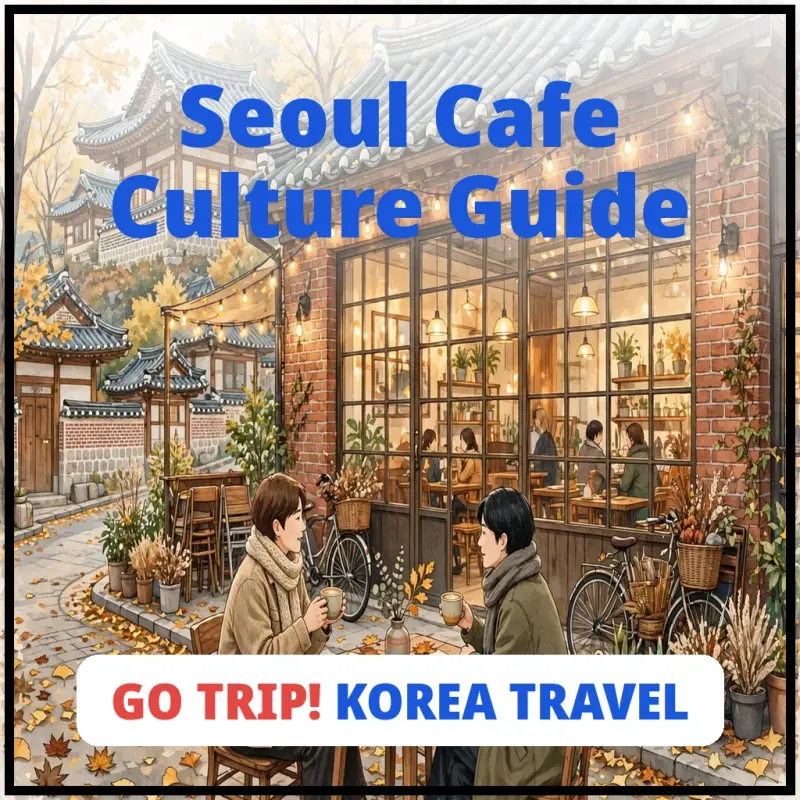
Seoul runs on cafes. The city has around 90,000 of them, and they are not just places to drink coffee: they are where friends meet, students study, couples go on dates, and travelers rest between sights. Some are converted factories, some are 1920s hanok houses, some are two-dimensional cartoon rooms, and some have meerkats. This guide explains how Seoul's cafe culture actually works — how to order, what it costs, the one rule every visitor should know, and the best cafe districts to build an afternoon around.
Read this first — prices and hours change fast. Popular cafes change menus, raise prices, and move opening hours with the seasons, and signature breads sell out by the afternoon. All prices below are planning ranges gathered in November 2026, not fixed quotes: re-confirm prices and hours on Naver Map before you go.
Key Takeaways
- The one rule: one drink per person (1인 1음료) — everyone using a seat orders at least one item. Small and tourist-area cafes enforce it strictly.
- Best first stop: Seongsu-dong, Seoul's warehouse-cafe district — Cafe Onion for bread, NUDAKE for dessert art, and Seoul Forest next door.
- Best slow afternoon: Ikseon-dong's 1920s–1930s hanok lanes, quieter than Hongdae or Seongsu on weekend afternoons.
- Budget roughly ₩6,000–15,000 per person for a drink plus a pastry at a normal cafe; themed and animal cafes charge ₩10,000–15,000 entry, usually including a drink.
- Order at a kiosk or the counter, then wait for your number. Kiosk English can switch back to Korean mid-order — the hot/iced and dine-in/takeout steps are where it happens.
1. How Ordering Works: Kiosks, Counters & the One-Drink Rule
Most Seoul cafes work the same way. You order at the counter or a touchscreen kiosk, pay by card (card payment is standard; cash is rarely needed), take a number buzzer or a receipt with your order number, and wait for your name or number to be called. There is usually no table service and no tipping.
Three Korean words cover most orders: 아이스 아메리카노 (aiseu americano, iced Americano — the most ordered drink in Korea), 포장 (pojang, takeaway), and 매장 (maejang, eating in). Choose carefully: ordering takeaway usually means no indoor seating, so pick "for here" if you want to sit down. On kiosks, the English mode can drop back into Korean mid-order — the hot/iced and dine-in/takeout steps are where it happens — so go slowly on those two screens.
The rule that surprises visitors most is 1인 1음료: one drink per person. Everyone using a seat is expected to order at least one item; some cafes accept a dessert instead, but do not assume it. It is also completely normal — and usually safe — to leave a laptop or bag to hold a seat for a short time while you order, though you should keep valuables on you. Working or studying with a laptop is fine at most cafes, but some popular spots post time limits at busy hours, so check the signs on the table.
2. Seongsu-dong: Warehouse Cafes & Seoul's Brooklyn
Seongsu-dong spent decades as an industrial zone — shoe factories, print shops, and auto repair garages in low-rise buildings near the Han River. Then the warehouses became cafes, and the neighborhood earned its nickname: "Seoul's Brooklyn." Today its main strips, Seongsui-ro and Yeonmujang-gil, mix artisan bakeries, brand pop-up stores, and designer flagships, with Seoul Forest park on its doorstep. Take Seongsu Station (Line 2), Exit 3.

Photo: CartoonChess / Wikimedia Commons (CC BY-SA 4.0)
Cafe Onion Seongsu — the one that started it
Cafe Onion opened in 2016 inside a former factory building from the 1930s era, when the site served the Gyeongseong Textile Mill, and showed a generation of cafe owners how raw concrete, exposed brick, and excellent pastries could draw crowds to an industrial neighborhood. It has three floors, vintage furniture, and rooftop seating when the weather cooperates. The signature item is the Pandoro (₩5,000), a tall star-shaped sweet bread dusted heavily in powdered sugar — meant to be torn by hand and shared. Address: 8 Achasan-ro 9-gil, Seongdong-gu. Hours are weekdays 08:00–22:00 and weekends 10:00–22:00. The timing that actually works is weekday mornings before 9 AM, when the bread is fresh out of the oven and the courtyard is calm; weekends after noon mean a wait and claimed sofa seats.
NUDAKE & Daelim Changgo — dessert art and the warehouse template
NUDAKE sits on the fifth floor of Haus Nowhere Seoul on Ttukseom-ro, a building that also holds Gentle Monster eyewear, Tamburins fragrance, and fashion labels, so the whole building can easily fill 90 minutes. Its art desserts run from ₩12,500 up to ₩48,000 for a full course; the Dutch Latte (₩9,000) and a Microissant set (₩2,500) are the lower-stakes entry points. Go right at opening (11 AM) to skip the line. Daelim Changgo, at 74 Seongsui-ro, is the old warehouse that started the whole template — red brick exterior, antique signage, cavernous open floor — and now also hosts the large Musinsa fashion store that opened there in 2024.

Photo: CHO woohyuck / Wikimedia Commons (CC BY-SA 4.0)
Between cafes, walk to Seoul Forest, the big park next door — a good place to eat takeaway bread when the cafes are full. Seongsu is also Seoul's pop-up capital: beauty, fashion, and snack brands open themed pop-ups on Yeonmujang-gil almost every week, often with free samples and photo zones. Photo booths are a local ritual here; strips cost about ₩4,000–6,000.
3. Ikseon-dong & Yeonnam-dong: Slow Hanok Afternoons
If Seongsu is Seoul's Brooklyn, Ikseon-dong is its slow lane. The neighborhood is a grid of low-rise lanes from the 1920s–1930s, now converted into hanok cafes, craft shops, and small restaurants. Crowd density is measurably lower than Hongdae or Seongsu on weekend afternoons, which makes it the natural choice when you want cafe-hopping without queue management. Reach it from Jongno 3-ga Station (Lines 1, 3, 5) or Anguk Station (Line 3). Expect about ₩6,000–10,000 for a drink, or ₩15,000–20,000 with dessert. Weekday mornings are quietest; Friday evenings bring alley congestion.

Photo: S h y numis / Wikimedia Commons (CC BY-SA 4.0)
Yeonnam-dong, near Hongdae, plays a similar role: a lower-intensity cafe neighborhood that rewards wandering rather than queuing. Both areas suit a simple plan — pick one cafe for coffee, one for dessert, and walk the lanes in between. The hanok-style Cafe Onion Anguk is the opposite mood from its Seongsu warehouse sibling and works well as a second stop if you are already in the Jongno area.
For a fuller day around these lanes, pair the cafes with the old-city sights nearby: see Bukchon Hanok Village Walking Guide for the route, photo spots, and quiet-hours etiquette.
4. Hongdae: Themed Cafes & Animal Cafes
Hongdae takes its name from Hongik University, which specializes in fine arts, and the neighborhood's creative identity has made it Seoul's most concentrated zone for concept-driven cafes: animal cafes, multi-floor themed buildings, and a street culture rooted in the campus next door. Start at Hongik University Station (Line 2 / Airport Railroad), Exit 9.
The best-known concept is the animal cafe. The Meerkat Cafe, on the 3rd floor of a Hongdae building, charges about ₩13,000 entry, which covers time with the animals. Cat and dog cafes, raccoon cafes, and meerkat cafes generally charge a ₩10,000–15,000 entry that includes a drink. The same idea extends beyond animals: 2D cartoon-style cafes, flower cafes, board-game cafes, and character pop-up cafes are all part of the Hongdae circuit. Budget about ₩8,000–12,000 per person for a normal concept cafe, plus the animal-cafe entry where it applies.
Two things to know before you go: animal cafes are busiest on Saturday and Sunday from noon to 4 PM, when Hongdae crowds peak, and many themed cafes have house rules (no flash photography, no feeding the animals, time limits) posted at the entrance — read them before you pay. If the queues look long, Yeonnam-dong's quieter cafes are a ten-minute walk away.
5. What It Costs & Practical Tips
Cafe prices in Seoul are moderate by global-city standards, but they add up fast on a cafe-hopping day. Typical ranges from November 2026 research — re-confirm on the official site or Naver Map, as individual cafes change prices often.
| Item | Planning range (KRW) |
|---|---|
| Coffee (Americano / latte) | ₩5,000–8,000 |
| Pastry or signature bread (e.g. Pandoro) | ₩5,000–10,000 |
| Per person, one drink + one pastry | ₩12,000–25,000 |
| Themed / animal cafe entry (usually incl. a drink) | ₩10,000–15,000 |
| Dessert-art cafe (e.g. NUDAKE) | ₩12,500–48,000 |
| Study cafe (pay by time) | ₩1,500–2,500 per hour |
| Photo booth strips (Seongsu) | ₩4,000–6,000 |
- Go early or go weekday. Crowds peak Saturday–Sunday 12:00–16:00 in Seongsu and Hongdae. Weekday mornings before 9 AM are the quiet window at the famous bakeries.
- One drink per person, every time. Budget for it; it is the price of the seat.
- Bakeries sell out. Signature breads are baked in batches and gone by the afternoon — go early for the famous ones.
- Takeaway means no seat. If you want to sit inside, order "for here" (매장), not takeaway (포장).
- Keep your receipt. Some cafes use it for the restroom code or the Wi-Fi password.
Sources for the prices and hours above: Ask Korea Travel's Seongsu cafes guide (2026), All K Cultures' Cafe Onion Seongsu guide (checked October 2026), Namane Card's Seoul themed cafes guide (2026), and Korea 101's Korean cafe culture guide (2026). Hours and prices change often — confirm on Naver Map before visiting.
🏨 Where to Stay in Seoul
Compare live prices on Seoul hotels — from Myeongdong and Hongdae to Gangnam and Seongsu. Booking through this link supports this blog at no extra cost to you.
Check Seoul Hotels on Trip.com
This post contains affiliate links. We may earn a commission at no extra cost to you.
Related reading: plan your Seoul days around the cafes with Seoul 3-Day Itinerary for First-Time Visitors, and handle money and transport with T-money Card Korea Guide.
FAQ
How much does a cafe visit cost in Seoul?
Budget about ₩6,000–15,000 per person for a drink plus a pastry at a normal cafe. Themed and animal cafes charge ₩10,000–15,000 entry, usually including a drink, and dessert-art cafes like NUDAKE start around ₩12,500. Re-confirm prices on Naver Map, as cafes change them often.
Do I have to order one drink per person in Seoul cafes?
Yes — the 1인 1음료 rule means everyone using a seat orders at least one item. Small and tourist-area cafes enforce it strictly; some accept a dessert instead, but do not assume it.
What is the best cafe area in Seoul for first-time visitors?
Seongsu-dong for warehouse cafes and Seoul Forest next door, Ikseon-dong for slow hanok-lane cafes, and Hongdae for themed and animal cafes. Start in Seongsu on a weekday morning to skip the lines.
Can I work or study in a Seoul cafe?
Yes, at most cafes — working and studying with a laptop is normal, and leaving a bag to hold a seat briefly is accepted. Some popular cafes post time limits at busy hours, and dedicated study cafes charge about ₩1,500–2,500 per hour for a quiet desk.
Where should I stay to be near Seoul's best cafes?
Seongsu, Hongdae, and Jongno (Ikseon-dong) all put you within walking distance of cafe clusters. You can compare Seoul hotels on Trip.com — this post contains affiliate links, and we may earn a commission at no extra cost to you.
0 comments