• Home
  • TRAVEL TO KOREA
  • SEOUL
  • BUSAN
  • JEJU
  • TRAVEL TIPS
  • ABOUT
Go Trip! Korea travel guide home

Key Takeaways

  • 2026 was the biggest season Korean baseball has ever had. The 720-game regular season drew 12,770,551 spectators, an average of 17,737 a game, and 345 of those games sold out (KBO, 13 October 2026).
  • The cheap seats are genuinely cheap. At Jamsil in 2026 an outfield seat listed at ₩10,000–11,000 and an infield seat at ₩16,000–26,000; at Gocheok an outfield seat started at ₩9,000. Online sales add a ₩1,000 booking fee per ticket.
  • Games start at 18:30 on weekdays, 17:00 on Saturdays and 14:00 on Sundays and public holidays. Mondays are the league’s day off, and a nine-inning game runs about three hours.
  • The ticket, not the game, is the hard part. Most Korean booking platforms ask for a Korean mobile number. KT Wiz sells through its own app to foreigners with an email address and an overseas card, and every other club still sells same-day seats at the stadium box office to passport holders.
  • Seoul’s ballpark map changes in 2027. 2026 was the last season at the 1982 Jamsil Baseball Stadium; LG and Doosan move to the Jamsil Olympic Main Stadium for 2027–2031 while a 30,000-seat domed ballpark is built on the old site.

Contents:

  • 1. Why a KBO Game Is the Best-Value Night Out in Korea
  • 2. How the Season Works: Dates, Start Times and the Postseason
  • 3. The Ten Stadiums and How to Reach Them
  • 4. Ticket Prices in KRW, Seat Class by Seat Class
  • 5. How to Buy a Ticket as a Foreigner
  • What a Full Game Night Costs
  • Food, Beer and How to Cheer
  • FAQ

1. Why a KBO Game Is the Best-Value Night Out in Korea


Korean baseball is not a quiet afternoon in a ballpark. It is a three-hour, full-voice event: a drum line and a cheer squad at the front of each seating block, a team song for every batter, plastic thundersticks in most hands, a fried chicken box balanced on a cup holder, and a stadium that stands up together in the seventh inning. You do not need to know the rules to enjoy it, and that is exactly why it belongs on a first trip to Korea.

The interior of Jamsil Baseball Stadium in Seoul, with tiers of seating around a floodlit green field

Photo: Christophe95 / Wikimedia Commons (CC BY-SA 4.0)

Jamsil Baseball Stadium, home of the LG Twins and the Doosan Bears from 1982 to 2026. The outfield seats are the cheapest way in, and the lower infield is where the view is worth the extra ₩6,000.

The numbers say the same thing. The 2026 KBO regular season, 720 games across ten clubs, drew 12,770,551 spectators, a record, with an average of 17,737 per game and 345 sellouts; seat occupancy ran at 85.4% (KBO, 2026 season records, 13 October 2026). Eight of the ten clubs passed one million home fans in a season for the first time in league history.

Put that next to the price of the ticket and the value is obvious. An outfield seat for a weekday game costs less than a cocktail in central Seoul. Two people can watch a game with a shared box of fried chicken and two beers for roughly the price of a mid-range dinner.

What you are buying, though, is not just baseball. It is the only place in Korea where a stadium of 20,000 people, a cheer squad, a mascot and a drumline are all working on the same song at once, and where nobody minds that you are singing the wrong words.

2. How the Season Works: Dates, Start Times and the Postseason

The KBO League has ten clubs, each playing a 144-game regular season across 720 games in total, running from late March into October. In 2026 the season opened on 28 March and the regular season ended on 12 October, followed by the postseason from 14 October and the Korean Series from 2 November (KBO 2026 schedule announcement; KBO postseason announcement). The league published the 2026 calendar on 19 December 2025, which is the pattern to expect: the following season’s fixtures usually appear in December.

Three things decide whether a game fits your trip.

  • Start times. Weekday games begin at 18:30, Saturday games at 17:00, and Sunday and public-holiday games at 14:00. In July and August the weekend times move back an hour, to 18:00 and 17:00, because of the heat; Gocheok Sky Dome keeps its 14:00 Sunday start because it is indoors (KBO start-time notice).
  • Mondays are off. The league normally schedules no games on Mondays during the season, so a Monday arrival in Korea means no baseball that night.
  • A game takes about three hours, plus 30–60 minutes to get in and out of a full stadium. Plan a weekday night from 18:00 to 22:00, or a Sunday afternoon from 13:30 to 17:30.

The postseason works as a ladder: a wild-card game between fourth and fifth, a best-of-five semi-playoff, a best-of-five playoff, then the Korean Series, best of seven. Postseason tickets are priced and sold differently from regular-season tickets, so the advice below applies to the regular season.

3. The Ten Stadiums and How to Reach Them


Every club has its own home ground and its own booking platform, which is the single most useful thing to understand before you plan a night out. Two clubs share Seoul’s Jamsil; the rest are spread across Incheon, Suwon, Daejeon, Daegu, Gwangju, Busan and Changwon.

Home club City Stadium Getting there
LG TwinsSeoulJamsil Baseball Stadium (1982)Sports Complex Stn (Lines 2, 9), Exit 5 or 6, 168 m
Doosan BearsSeoulJamsil Baseball Stadium (1982)As above, or Jamsil Stn (Lines 2, 8)
Kiwoom HeroesSeoulGocheok Sky Dome (indoor)Guil Stn (Line 1), Exit 2, 330 m
SSG LandersIncheonIncheon SSG Landers FieldMunhak Sports Complex Stn (Incheon Line 1), Exit 2, 5 min walk
KT WizSuwonSuwon KT Wiz ParkNo station nearby: bus 82 or 83-1 from Suwon Stn, about 15 min
Hanwha EaglesDaejeonDaejeon Hanwha Life BallparkYongdu Stn (Daejeon Line 1), about 15 min on foot; taxi from the centre
Samsung LionsDaeguDaegu Samsung Lions ParkBus or taxi from central Daegu (about 20 min)
KIA TigersGwangjuGwangju-Kia Champions FieldBus or taxi from the city centre
Lotte GiantsBusanSajik Baseball StadiumSajik Stn (Busan Line 3), Exit 1, about 560 m
NC DinosChangwonChangwon NC ParkBus or taxi from Changwon city centre

Access notes come from the clubs’ own stadium pages and the Seoul and Busan tourism boards. Clubs occasionally change gates and shuttle arrangements, so check the club page for the day you are going.

A full Incheon Munhak Baseball Stadium during a night game, with the crowd filling the stands behind the infield

Photo: redjef25 / Wikimedia Commons (CC BY 2.0)

A sold-out night at Munhak in Incheon, now the SSG Landers Field. Regional grounds sell out too: 345 of the 720 games in 2026 were sellouts.

If you only have one night in Seoul, go to Jamsil. It is the biggest ballpark in the country, both Seoul clubs play there, and it sits between two subway stations: Sports Complex Station on Lines 2 and 9 (Exit 5 or 6, 168 m from the ground) and Jamsil Station on Lines 2 and 8. Because it is the home of two clubs, check which one is hosting before you buy; the ticket windows are separate.

If the forecast is bad, go to Gocheok Sky Dome. It is Korea’s first domed ballpark, home of the Kiwoom Heroes, with 18,000 seats, and it is the one ground where a rainy July afternoon still means baseball. It is a three-minute walk from Guil Station Exit 2 on Line 1.

Inside Gocheok Sky Dome in Seoul during an international tournament, the roof closed and the stands full

Photo: Trainholic / Wikimedia Commons (CC BY-SA 4.0)

Gocheok Sky Dome, the only indoor ballpark in the league. Summer prices are higher here, but the roof means the game happens whatever the weather.


Other clubs sit inside the same band. As a rule of thumb for 2026: outfield ₩7,000–13,000, ordinary infield ₩14,000–30,000, table and premium seats ₩35,000–100,000. The cheapest useful seat for a first game is the outfield or upper infield; the best value is "Navy" or "Red" in the lower infield, where you get the view without the premium price. The Orange and Blue blocks are where the cheer squad works, so they sell out first.

5. How to Buy a Ticket as a Foreigner

This is where most visitors get stuck, so it is worth being precise. Korean baseball tickets are sold through the clubs’ own platforms, and the KBO lists them club by club: a reservation line for LG, Hanwha, Samsung, KT and KIA, another for Doosan and Kiwoom, and separate club systems for SSG, Lotte and NC (KBO ticket information). Almost all of them were built for Korean residents: registration typically runs through mobile-carrier or resident-number verification.

Route 1: KT Wiz’s Wizzap app (the one official online path for foreigners). KT Wiz, the Suwon club, released an English version of its official app with a foreign-member tier: register as a foreigner with an email address and email verification, no Korean phone number, and pay with an overseas-issued card. KT announced this in March 2024 explicitly to open advance booking to foreign fans (Maeil Business Newspaper, 21 March 2024). If your dates include a Suwon home game, this is the least friction you will find anywhere in the league.

Route 2: the stadium box office, with your passport. Every club sells remaining seats at the ground on game day, and this is how most short-stay visitors get in. Box offices generally open 1.5 to 2 hours before the first pitch — LG’s opened 90 minutes early on weekdays and two hours early at weekends — and you need a physical passport, because the counter is also the proof that you cannot use the Korean online system.


In 2026 the two Jamsil clubs went further and set aside seats for foreign buyers. LG ran a dedicated foreign window at Ticket Office No. 3, the "Digital Assistance Window", on the left as you come out of Sports Complex Station Exit 5: a set pool of 10 Blue, 30 Red and 80 Green seats on each side of the ground, up to two tickets per person, passport required. Doosan ran its own ticket counter with a similar set-aside pool, one ticket per person and a passport check. Those arrangements belonged to the old Jamsil ballpark and the clubs have not announced how they will work at the Olympic Main Stadium in 2027, so check the club notice on the day.

Route 3: buying online before you fly. If you are a resident with a Korean number and card in your own name, the ordinary club platforms work normally. If you are not, do not count on a workaround: several English guides recommend "global" versions of the big Korean ticketing sites, but those versions do not reliably carry baseball inventory. Sales also open on a schedule — normally seven to eight days before the game, at 11:00 or 14:00 KST depending on the club — and popular fixtures (LG vs Doosan at Jamsil, any weekend series in Busan or Daegu) sell out within minutes.

The one rule that matters: a game that sells out online has no box-office inventory. If the club’s page shows a sellout, do not travel to the ground hoping for a return ticket; go to a different game. If you want the safest plan, pick a Tuesday-to-Thursday game between mid-table clubs, arrive at the box office about 90 minutes before the first pitch, and bring your passport.

What a Full Game Night Costs

These are 2026 prices for the things a visitor actually buys at a Seoul game.

Item Cost (KRW, 2026) Notes
Jamsil outfield seat₩10,000–12,000Weekday to weekend; the cheapest way in
Jamsil infield seat (Navy to Blue)₩16,000–26,000Best view for the money
Gocheok outfield seat₩9,000–13,000Higher in the 19 May–6 September summer window
Online booking fee₩1,000 per ticketCharged by the ticketing platform
Subway, each way₩1,550T-money card fare; ₩1,650 for a single-ride card
Draft beer inside the stadium₩4,000–5,000Plastic cup; ID checked for alcohol
Fried chicken inside the stadium₩23,000–30,000A whole box; stadium branches price above their street menus
"One-shot" chicken cup₩12,000–15,000Chicken, fries and a drink in one cup at Jamsil
Fried chicken from the market near JamsilFrom about ₩15,000About ₩15,000 for 600 g of sweet-and-spicy chicken in the market, against ₩22,000–25,000 at the stadium-side stalls
Two people, one gameAbout ₩60,000–90,000Two outfield or lower-infield tickets, one chicken, two beers, subway both ways

Prices are what the clubs, stadium outlets and markets listed in 2026; the two-person total is our arithmetic from the rows above, not a quoted package. Re-confirm on the club’s ticket page and at the counter.


Two money notes. First, cash is worth carrying for the stalls outside the ground and for the ticket window, even though most stadium outlets take cards. Second, the subway fare is the cheapest part of the night and the fastest way out after the final out; our T-money card guide covers where to buy and top up a card, and the Korea travel money guide covers cards, cash machines and exchange.

 Where to Stay in Seoul

For a Jamsil game, Songpa-gu puts you a subway stop or two from Sports Complex Station and 25 minutes from Gangnam; for Gocheok, the western Line 1 corridor around Guil and Guro is the practical choice. Compare live prices on Seoul hotels on Trip.com — booking through this link supports this blog at no extra cost to you.

Check Seoul Hotels on Trip.com

This post contains affiliate links. We may earn a commission at no extra cost to you.

Food, Beer and How to Cheer

Food is not a side note in Korean baseball; it is half the reason people go. The default order is chimaek — chicken and beer — and the stadium is built around it: cup holders on the seat backs, chicken counters on the concourse, beer vendors walking the aisles, and convenience stores on every level.

A plate of Korean fried chicken, half glazed in red sauce and half plain, with pickled radish

Photo: KOREA.NET / Wikimedia Commons (CC BY-SA 2.0)

Korean fried chicken, the other half of chimaek. A whole box runs ₩23,000–30,000 inside a ballpark, so many fans buy one outside and carry it in.

The rules differ by ground, and they are enforced at the gate.

  • Outside food. Jamsil allows it, which is why crowds walk in from Jamsilsaenae Station with market chicken and mandu. Gocheok is stricter. Changwon and Daegu do not allow it at all. Assume the strictest reading and check the club notice if you are carrying a full meal.
  • Alcohol. Cans and glass bottles are refused everywhere; a sealed plastic bottle of 1 litre or less is the outer limit at grounds that allow any, and the decision sits with the gate staff. The reliable route is to buy beer inside.
  • Bags are opened and checked at the gate, quickly and without drama. Leave the picnic knife and the glass bottle at the hotel.
  • Delivery is now part of the culture: Jamsil, Gocheok, Incheon and Suwon run designated delivery pickup zones. At Jamsil they are near Exits 5 and 6 of Jamsilsaenae Station and by the central ticket plaza; at Gocheok it is the Guil Station Exit 2 side. Korean delivery apps need a Korean number, so this is a local habit more than a visitor option.
Fans in the stands at Jamsil Baseball Stadium raising their arms and cheering during a game

Photo: Christophe95 / Wikimedia Commons (CC BY-SA 4.0)

The supporters’ block at Jamsil. Each team brings a drum, a cheer squad and a song for every batter in the lineup.


How to cheer. Home fans normally sit on the first-base side and away supporters on the third-base side, each with their own cheer squad, drum and songs. Every batter has a song, the crowd sings it in unison, and nobody expects a foreigner to know the words — clapping on the beat is enough. Stand for the seventh-inning stretch, keep your drink off the seat in front of you, and take your rubbish to the bins on the way out: Korean stadiums run a reusable-cup return system, and the return points are marked.

One practical warning about the weather: rain cancels games, and a cancelled game is rescheduled to a later date. If you are in Korea for only a few days, an indoor Gocheok game in the rainy season is the safer booking. For getting around between games, our guide to navigating Korean subways and apps covers the transfers, and the Seoul 3-day itinerary shows where a game fits into a short trip. If Busan is on your route, the Busan 2-day itinerary pairs a Sajik night with the harbour markets.

FAQ

Where can I buy Jamsil baseball tickets for foreigners?


At the ground. LG and Doosan both sold same-day seats to foreign visitors in 2026 at their own ticket counters, with a passport and no Korean phone number: LG at Ticket Office No. 3 (the Digital Assistance Window) near Sports Complex Station Exit 5, up to two tickets per person, and Doosan at its own counter, one ticket per person. Counters open about 1.5–2 hours before the first pitch. Those were the arrangements at the old Jamsil ballpark, so check the club notice for the 2027 venue.

How much does a KBO ticket cost?

In 2026 an outfield seat cost ₩9,000–13,000 depending on the ground, an ordinary infield seat ₩14,000–30,000, and table or premium seats ₩35,000–100,000. At Jamsil specifically, outfield seats were ₩10,000–12,000 and lower-infield seats ₩19,000–26,000. Add a ₩1,000 online booking fee if you book ahead.

When is baseball season in Korea, and what about 2027?

The regular season runs from late March to October, followed by the postseason and the Korean Series in late October or early November. For 2027, the league normally publishes its fixture list in December, so check the KBO site before booking flights around a specific game.

Is Jamsil Baseball Stadium still open in 2027?

No. The 1982 ballpark closed after the 2026 season and is being demolished, with a 30,000-seat domed ballpark planned for the site. LG and Doosan will play at the Jamsil Olympic Main Stadium for the 2027–2031 seasons, with a reduced capacity of about 18,000 and a different set of entrances, so treat 2026-era directions with care and follow the club’s 2027 guide.

Do I need to speak Korean, and can I bring food?

No Korean is needed to watch a game — the play is self-explanatory and the crowd does the explaining. Food is allowed at Jamsil and most grounds, but no cans or glass, a maximum of 1 litre in a plastic bottle, and the gate staff have the final say; Changwon and Daegu do not allow outside food at all. Beer is sold inside for about ₩4,000–5,000 a cup, and ID is checked.


Sources: Korea Baseball Organization (2026 season schedule, postseason schedule, start-time notice, 2026 season records, ticket and booking information), Seoul Metropolitan Government (Jamsil Olympic Main Stadium as the 2027–2031 substitute ballpark, 9 July 2024), Yonhap News Agency (2026 attendance record and Jamsil’s final regular-season game, 12 October 2026), Seoul Shinmun (substitute ballpark capacity and layout, 15 July 2026), Kiwoom Heroes official 2026 ticket prices, LG Twins and Doosan Bears ticket notices, KT Wiz and Maeil Business Newspaper (Wizzap English version for foreign members, 21 March 2024), Visit Seoul (Jamsil Baseball Stadium access, Gocheok Sky Dome access and facilities), Busan Metropolitan City and Lotte Giants (Sajik Stadium access), SSG Landers (Munhak access), Seoul city transport fare table (T-money ₩1,550). Prices, gate rules and box-office arrangements change every season — re-confirm on the club’s official page before you travel.


  • 0 Comments
Korean temple food guide — plant-based temple dishes in front of a Korean temple

Korean temple food (sachal eumsik) is one of the quietest meals you can eat in Korea — and one of the most surprising. There is no meat, no fish, and famously no garlic or onion, yet a temple table can hold a dozen small dishes that taste bright, deep, and completely different from everyday Korean food. This guide explains what temple cuisine is, why it tastes the way it does, and exactly where foreigners can try it — in Seoul restaurants, in a one-day cooking class, or inside a temple itself.

Key Takeaways

  • Temple food is plant-based by principle: no meat or fish, and no osinchae — the five pungent vegetables (garlic, green onions, leeks, chives, and scallions) that Buddhist practice says disturb calm meditation.
  • Flavor comes from fermentation and seasonality, not from strong seasoning: homemade doenjang, ganjang, pickled vegetables (jangajji), mushrooms, and mountain greens do the work.
  • Easiest first taste in Seoul: Balwoo Gongyang (a full temple-food course near Jogyesa Temple) or Sanchon in Insadong (seasonal temple-style dishes).
  • Hands-on option: the Korean Temple Food Center in Insadong runs a one-day temple food class for foreigners — book ahead, as places are limited.
  • Deepest experience: join a Templestay program, where temple meals are part of the stay. Check the official Templestay site for current temples, dates, and prices before booking.

Contents

  • 1. What Is Korean Temple Food?
  • 2. The Rules: What Is (and Is Not) on the Plate
  • 3. What to Eat: Signature Dishes and Seasonal Flavors
  • 4. Where Foreigners Can Try Temple Food
  • 5. Planning, Costs, and Etiquette
  • FAQ

1. What Is Korean Temple Food?

Sachal eumsik means "temple food" — the meals prepared and eaten by Buddhist monks in Korean temples as part of their spiritual practice. Korea's official cultural portal, Korea.net, describes it as vegetarian cuisine rooted in compassion and the Buddhist principle of not taking life, with meals treated as an offering (gongyang) and an act of gratitude for nature and for the labor behind each ingredient.

Temple food is not a modern diet trend. It grew over centuries inside mountain monasteries, where monks cooked with what the mountain and the temple garden provided: wild herbs, roots, mushrooms, seaweed, grains, beans, and tofu. Because temples were often far from markets, preservation became a craft — fermentation, drying, and pickling turned a short harvest into year-round flavor. That is why a temple meal today still tastes like a place and a season, not like a recipe built around one strong sauce.

Global attention surged after the Netflix series Chef's Table featured Venerable Jeong Kwan of Baekyangsa Temple in 2017, introducing temple cooking to travelers who had never heard of it. Visit Korea now presents temple food as one of Korea's signature culinary experiences, and the Cultural Corps of Korean Buddhism runs dedicated venues in Seoul for visitors who want to taste it without traveling to a mountain temple.

A note on status: temple food is sometimes described online as "UNESCO food." As of this writing it is not on UNESCO's Intangible Cultural Heritage list — Korean cultural bodies have described nomination as a future step, not a completed inscription. What is certain is that it is a living, centuries-old tradition, and that is reason enough to try it.

Jogyesa Temple in Seoul, near Balwoo Gongyang temple food restaurant

Photo: Severin.stalder / Wikimedia Commons (CC BY-SA 3.0)

2. The Rules: What Is (and Is Not) on the Plate

Temple cooking follows a small set of rules, and those rules explain almost everything about the flavor.

No meat, no fish

Out of respect for life, temple kitchens use no meat, fish, or seafood — and traditionally no artificial flavor enhancers either. Protein comes from tofu, beans, mushrooms, and grains instead.

No osinchae — the five pungent vegetables

The most distinctive rule is the exclusion of osinchae, the five pungent vegetables: garlic, green onions, leeks, chives, and scallions. Korea.net and Visit Korea both list these five; in most temples, onion is avoided under the same reasoning. Buddhist teaching holds that these stimulating alliums agitate the mind and disturb the stillness meditation requires. This is a monastic discipline, not a rule for lay Buddhists — but it is what makes temple food taste so different from the garlic-forward Korean food most visitors know.

Fermentation does the heavy lifting

Without garlic and onion, flavor has to come from elsewhere. Temple cooks rely on:

  • Doenjang (fermented soybean paste) and ganjang (soy sauce), often made at the temple and aged for months or years.
  • Jangajji — vegetables pickled in soy sauce or vinegar, adding salt, sourness, and crunch.
  • Gochujang in temple-adapted form (often without garlic), used lightly rather than as a dominant heat.
  • Natural umami from mushrooms, seaweed, sesame, and perilla oil.

The result is food seasoned to let each ingredient taste like itself. Expect subtle, clean flavors rather than bold spice — and do not expect a temple meal to taste like a "vegan version" of barbecue or fried chicken. It is its own cuisine.

3. What to Eat: Signature Dishes and Seasonal Flavors

There is no single fixed temple menu — dishes change with the season, the temple, and the cook. These are the kinds of dishes you are most likely to meet:

Seasonal mountain greens (namul)

Blanched or lightly seasoned wild greens and mountain herbs, dressed with sesame oil and a little soy sauce. Spring brings tender shoots; autumn brings roots and mushrooms. If a dish tastes quietly bitter, earthy, or grassy, that is intentional — temple cooking values the ingredient's own character.

Mushroom gangjeong

Visit Korea singles out Balwoo Gongyang's assorted mushroom gangjeong — crispy glazed mushrooms with a savory sauce — as a signature dish. Mushrooms appear in many forms in temple food: simmered in clear broth, pan-seared with aged soy sauce, or dressed with sesame.

Tofu, simply treated

Tofu is gently simmered in clear broth, pan-seared and dressed with aged soy sauce, or served with mountain greens. It is not a meat substitute here; it is a main ingredient in its own right.

Temple kimchi and pickles

Temple kimchi is made without fish sauce or shrimp paste — a useful fact if you are vegan, since most commercial kimchi is not. Ask before assuming, though: recipes vary by temple and restaurant.

Lotus-leaf rice and seasonal specialties

Some temples are known for a signature preparation — for example, steamed rice wrapped in a lotus leaf at Bongseonsa Temple, according to Templestay program materials. Seasonal course menus at restaurants like Balwoo Gongyang change through the year, so a spring visit and an autumn visit can taste quite different.

Korean temple cuisine dishes served at Sanchon restaurant in Seoul

Photo: Richy! / Wikimedia Commons (CC BY-SA 2.0)

4. Where Foreigners Can Try Temple Food

You do not need to stay overnight at a temple to try temple food. Here are the most foreigner-friendly routes, from easiest to deepest.

Balwoo Gongyang, Seoul — the classic course meal

Balwoo Gongyang is a temple cuisine restaurant operated by the Jogye Order of Korean Buddhism, located in front of Jogyesa Temple in central Seoul. Visit Korea describes it as offering four signature courses — Seon (Meditation), Won (Vow), Maeum (Mind), and Hee (Joy) — inspired by the path to enlightenment, built from seasonal ingredients.

  • Address: 5F, Templestay Information Center, 56 Ujeongguk-ro, Jongno-gu, Seoul
  • Hours (as listed by Visit Korea): 11:30–21:00, with a break 15:00–18:00; closed on Sundays
  • Phone: +82-2-733-2081
  • Website: eng.balwoo.or.kr — check the current menu and prices there before visiting

Visit Korea describes Balwoo Gongyang as a Michelin-starred temple food restaurant. Menus and star status can change, so confirm the current course lineup on the official site before you go — and book ahead, especially for dinner.

Sanchon, Insadong — seasonal temple-style dining

Sanchon is a long-running temple-cuisine restaurant in Insadong, near Anguk Station (Seoul Subway Line 3). Its menu changes with the seasons and centers on vegetables and mountain herbs. One important detail for strict temple-food eaters: Sanchon normally includes some of the five pungent ingredients (such as garlic and shallots) to suit a wider audience, but it will prepare dishes without them if you ask at least one day in advance. If a strict no-osinchae meal matters to you, request it when you reserve — do not assume it.

Korean Temple Food Center, Insadong — the one-day class

The Korean Temple Food Center in Insadong runs "Let's Learn Korean Temple Food," a one-day introductory workshop designed for international visitors, usually held on Saturdays. Earlier coverage reported the class at KRW 10,000 with advance reservation; the center's phone is +82-2-733-4650. Confirm the current schedule and price before you go — class times and fees change, and places are limited.

Inside a temple — Templestay programs

Templestay program materials describe around 130 temples across Korea running Templestay programs, some of which include temple-food making experiences: Baekyangsa Temple (home of Venerable Jeong Kwan of Chef's Table fame), Jingwansa Temple, Bongseonsa Temple (lotus-leaf rice), and Donghwasa Temple are among those highlighted for food experiences. Meals are part of the stay, and English-language programs exist at selected temples — including Bongeunsa Temple in Seoul, according to earlier Templestay listings. Check the official site eng.templestay.com for current programs, language availability, and prices, which vary by temple.

Lotus Lantern Festival at Jogyesa Temple in Seoul

Photo: Ken Eckert / Wikimedia Commons (CC BY-SA 4.0)

5. Planning, Costs, and Etiquette

Cost guide

ExperienceWhat you getPrice note (2026)
Korean Temple Food Center classOne-day introductory temple food class for foreignersReported at KRW 10,000 in earlier coverage — confirm current price before booking
Balwoo Gongyang courseMulti-course seasonal temple cuisine near Jogyesa TempleVaries by course — check eng.balwoo.or.kr
Sanchon mealSeasonal temple-style dishes in InsadongMid-range restaurant pricing — check the menu before visiting
Templestay programOvernight stay with temple meals and activities includedIncluded in the program fee — varies by temple, see eng.templestay.com

[Note] Prices change and vary by season and program. Always re-confirm the current price on the official site or by phone before booking. The KRW 10,000 class price above comes from earlier press coverage, not a live 2026 price check — treat it as a reference, not a quote.

🏨 Where to Stay in Seoul

Compare live prices on Seoul hotels — from Myeongdong and Hongdae to Gangnam. Booking through this link supports this blog at no extra cost to you.

Check Seoul Hotels on Trip.com

This post contains affiliate links. We may earn a commission at no extra cost to you.

Etiquette tips

  • Book ahead. Balwoo Gongyang courses, the Temple Food Center class, and Templestay programs all have limited places. Walk-ins risk a long wait or a missed class.
  • Say so about strict diets. "Temple-style" restaurant dishes are not always strict osinchae-free — at Sanchon, for example, you must request it a day ahead. Vegans should also ask about egg and dairy in specific dishes.
  • Eat quietly and finish what you take. In a temple, a meal is a practice: take only what you will eat, eat mindfully, and follow the temple's guidance on silence and cleanup. At a restaurant, the same respect — no waste, no fuss — is appreciated.
  • Dress modestly at temples. Cover shoulders and knees, remove shoes where asked, and keep your voice low in halls and courtyards.
  • Pair it with a temple visit. Balwoo Gongyang sits in front of Jogyesa Temple, so combine lunch with a walk through the temple grounds — and if you are in Busan, our Haedong Yonggungsa Temple guide covers a seaside temple worth the trip.

FAQ

Q: Is Korean temple food vegan?

A: Almost entirely. Temple kitchens use no meat, fish, or seafood, and temple kimchi avoids fish sauce — but recipes vary by temple and restaurant, so strict vegans should ask about egg and dairy in individual dishes before ordering.

Q: Why is there no garlic or onion in temple food?

A: Buddhist practice excludes osinchae — garlic, green onions, leeks, chives, and scallions — because these pungent vegetables are believed to stimulate desire and disturb the calm needed for meditation. Flavor instead comes from fermentation, mushrooms, seaweed, and seasonal mountain greens.

Q: Can I try temple food without staying overnight at a temple?

A: Yes. Balwoo Gongyang and Sanchon in Seoul serve temple cuisine as restaurant meals, and the Korean Temple Food Center in Insadong offers a one-day class. Overnight Templestay programs are the deeper option, not the only one.

Q: Do I need a reservation?

A: Strongly recommended. Balwoo Gongyang courses and the Temple Food Center class have limited seats, and Templestay programs require advance booking through eng.templestay.com. For Seoul stays around your visit, you can compare hotels on Trip.com. This post contains affiliate links. We may earn a commission at no extra cost to you.

Q: Is temple food spicy?

A: Usually not very. Most temple dishes are mild and lightly seasoned so the ingredient's own flavor comes through. Some dishes use temple-style gochujang and can carry gentle heat — ask the staff if you are sensitive to spice.

Keep Exploring Korean Food and Temples

If temple food leaves you curious about the rest of Korean cuisine, start with our Korean BBQ guide for foreigners for the opposite end of the flavor spectrum, or our convenience store food guide for everyday eats. For the temple-stay experience itself — sleeping, meditating, and eating inside a temple — see our Korean temple stay guide.

Sources: Visit Korea, "Korean Temple Food: A Sustainable Cuisine Inspired by Buddhist Teachings" (english.visitkorea.or.kr); Korea.net, temple food feature (korea.net); Templestay program materials via eng.templestay.com and eng.balwoo.or.kr. Prices, hours, and class schedules change — always confirm on the official site before visiting.


  • 0 Comments

Key Takeaways

  • Makgeolli is rice, nuruk and water, fermented for one to two weeks and then roughly filtered. That is why it is cloudy, faintly fizzy and low in alcohol — usually 4 to 7% ABV, against 16 to 20% for soju.
  • A 750 ml bottle costs about ₩1,800–2,300 at a convenience store or supermarket (November 2026 prices), which makes it the cheapest way to taste Korea’s oldest drink. Premium draft makgeolli runs to about ₩3,400.
  • Everything else in the family comes from the same brew. Filter makgeolli and you get cheongju (15–18%); distil cheongju and you get traditional soju (Andong soju is 45% by tradition). Always read the number on the label, not the name.
  • Seoul has free tastings. The Sool Gallery in Bukchon pours themed selections at no charge, with English sessions at 15:00 and 16:00, Tuesday to Sunday — register on site before the session starts.
  • Manners matter more than the brand. Never pour your own glass, pour for the oldest person first with two hands, and turn your head slightly away as you drink in front of someone older. The legal drinking age is 19, and shops do check — carry your passport.

Contents:

  • 1. What Makgeolli Is, and How It Is Served
  • 2. How It Is Made: Nuruk, Two Weeks and a Rough Filter
  • 3. Reading the Label: Makgeolli, Cheongju, Soju and Fruit Wine
  • 4. Buying It: Convenience Store, Bottle Shop and Online
  • 5. Where to Drink It in Seoul, What to Eat and What It Costs
  • FAQ

1. What Makgeolli Is, and How It Is Served

Makgeolli is Korea’s unfiltered rice wine: a milky, slightly sour, lightly carbonated drink that is poured into a bowl rather than a glass. The Korea Tourism Organization calls it the drink with the longest history among Korean alcohols, and the name itself is a description — mak means freshly or simply, geolli means filtered, so makgeolli is “the liquor that was just strained” (VisitKorea: Makgeolli, the People’s Brew).

It has been recorded since the earliest written history on the peninsula: the Samguk sagi (History of the Three Kingdoms) and the Joseon wangjo sillok (Annals of the Joseon Dynasty) both list it under its other name, takju, which is still the legal name on the bottle. More than a thousand varieties are produced in Korea today.

On the table it is informal. A bottle or a brass kettle comes out, the drink is poured into a small ceramic bowl, and everyone reaches for the side dishes. At home and at a restaurant you shake the bottle first, because the rice sediment settles at the bottom — the cloudiness is the point, not a defect. Makgeolli is at its best cold and fresh, and in the old farming year it was part of saecham, the meal-between-meals that kept people going in the fields, which is why it still tastes like a hot-weather drink.

Two things surprise first-time drinkers. It is weaker than it feels: most bottles sit at 4–7% ABV — roughly beer strength, sometimes less — and the sweetness makes it go down faster than that number suggests. And it is not a bar-only drink. It is a supermarket product, sold in plastic bottles next to the beer.

Makgeolli poured from a brass kettle into ceramic bowls at a table in Seoul

Photo: Jon Åslund / Wikimedia Commons (CC BY 2.0)

Makgeolli arrives at the table in a kettle and leaves in bowls. The pour is the whole ritual — nobody measures, and the bowl gets refilled before it is empty.

2. How It Is Made: Nuruk, Two Weeks and a Rough Filter

Three ingredients decide everything: rice (or wheat), water and nuruk, the fermentation starter. Nuruk is a cake of grain cultivated with mould and yeast, and it does the work that malt does in beer and koji does in sake. The Korea Tourism Organization describes the basic method plainly — mix steamed rice or wheat with nuruk and water, ferment for one to two weeks, then strain it roughly (VisitKorea). Other producers work in stages, adding steamed glutinous rice and more nuruk in a second round and fermenting for 10 to 15 days before filtering (VisitKorea: Andong Soju).

Because the filtering is coarse, live yeast and lactic acid bacteria stay in the bottle. That is what gives makgeolli its tang and its fizz, and it is also why the drink is fussy: it keeps fermenting, so it is sold refrigerated and should be drunk young. The tourism organisation makes the same point about draft makgeolli (saeng makgeolli) — the microorganisms make transport and long storage difficult, which is why most regional makgeolli never leaves its province (VisitKorea).

Pasteurised makgeolli solves the storage problem at a cost. Heat treatment stops the fermentation and lets the bottle sit at room temperature for months, but the trade-off is the same one Korea’s tourism authority notes for unpasteurised versus pasteurised Hansan Sogokju: the treated version keeps its shape and loses some of its fragrance (VisitKorea: Hansan Sogokju). In practice: buy the chilled bottle from the fridge, keep it cold, and drink it within a few days of opening.

A brewer in Busan holding a disc of nuruk, the fermentation starter, in a drying room

Photo: Republic of Korea / Wikimedia Commons (CC BY-SA 2.0)

A brewer at Geumjeongsanseong Makgeolli in Busan with a disc of nuruk. The starter, not the rice, is where most of the flavour is decided.

3. Reading the Label: Makgeolli, Cheongju, Soju and Fruit Wine

Korean traditional liquor is one family with four branches, and they are separated by what happens after fermentation. Knowing the branch tells you the strength before you order.

Makgeolli and dongdongju — cloudy, 4–7%

Makgeolli is the cloudy, coarsely strained brew. Leave more of the rice in it and you have dongdongju, the same drink with grains floating on top, served from a clay pot with a ladle. Regional versions are where the variety lives: Jangsu and Jeonju makgeolli, Mungyeong’s omija makgeolli, Gangwon’s corn makgeolli, Udo Island’s peanut makgeolli, and Haenam’s Haechang Brewery, which bottles a 6% basic makgeolli alongside 9%, 12% and an 18% top grade (VisitKorea).

Cheongju — clear, 15–18%

Let the sediment settle and draw off the clear liquid and you have cheongju, the refined rice wine that Korea uses for rituals and gifts. It is 15–18% ABV, sweeter and more aromatic than makgeolli (VisitKorea). Two names worth knowing: Gyeongju Gyodong Beopju, brewed in two stages and aged, sold in gift boxes — the tourism organisation’s regional guide lists its Songhak No. 1 bottling from ₩40,000, a 2023 figure to re-check before buying — and Hansan Sogokju from Seocheon, a sweet 18% cheongju fermented for about 100 days with red chilli added (VisitKorea).

Traditional soju — distilled, 20–45%

The green bottle of diluted soju that costs ₩2,000 at a convenience store is not this. Traditional soju is distilled from a cheongju-style base, the way whisky is distilled from a fermented mash. Andong soju is the benchmark: the distillation yields 45% ABV, then water brings it down, and the market also sells 20–35% versions (VisitKorea). Jeonju Leegangju is the gentler entry, an infusion of pear, ginger, cinnamon and honey at 19% (Leegangju official site). Fruit wines such as bokbunja (Korean black raspberry) are the sweet end of the shelf, usually served in small glasses as a digestif rather than with a meal.

For a first purchase, the rule is simple: read the ABV number. The same word on two labels can mean 5% and 45%.

A row of different Korean makgeolli bottles on a table, from draft makgeolli to regional brands

Photo: Walnussbäumchen / Wikimedia Commons (CC0)

The shelf in miniature: draft makgeolli in plastic bottles, each region with its own label and its own sweetness. The ABV is printed small near the volume.

4. Buying It: Convenience Store, Bottle Shop and Online

Korea makes this easy. The tourism authority notes that makgeolli and soju can be bought at markets and convenience stores from Seoul to the smallest town, and that is literally true: every convenience store and supermarket chills 750 ml plastic bottles of draft makgeolli next to the beer (VisitKorea: Traditional Liquors & Wines). Expect to pay ₩1,800–2,300 for a standard bottle and about ₩3,400 for a premium brand such as Neurin Maeul.

Where the better bottles are

For anything above the supermarket tier, the same tourism guide points to specialty liquor shops, department store liquor sections and regional specialty stores — the premium bottles are boxed for gifts and priced accordingly. If you want to meet the producer, the Ministry of Agriculture, Food and Rural Affairs runs a “visiting breweries” programme, listed in English and Korean at thesool.com, and many breweries offer tasting and experience sessions (VisitKorea).

What you can and cannot buy online

This is the rule most visitors get wrong. Korea does not allow ordinary online liquor sales: a producer of beer, soju or cheongju may not run an internet shop. Approved traditional-liquor producers may — they need the district tax office’s approval, adult verification and order records, and since the current rules took effect they may run as many sales pages as they like (National Tax Service notice on online liquor sales). Two practical consequences: an online order shipped to your hotel is realistically a traditional-liquor order, and restaurant food delivered by app may include alcohol when the drinks are no more than half the order total (NTS).

Age and ID

The legal drinking age is 19, counted from 1 January of the year you turn 19, and it applies to visitors exactly as it does to Koreans (Visit Seoul: Miscellaneous). The seller carries the legal duty to check, so a passport is the document that always works; a foreign driving licence is not named in the rules and a shop may refuse it.

White porcelain bottles of Andong soju, a traditional Korean distilled liquor, marked 45 percent

Photo: Matt and Nayoung Wilson / Wikimedia Commons (CC BY 2.0)

Andong soju in its porcelain bottle, marked 45% and 400 ml. This is the gift-shop end of the shelf, not the convenience-store end.

5. Where to Drink It in Seoul, What to Eat and What It Costs

Makgeolli is drunk with food, and the food is half the reason. The classic pairing is jeon — a pancake — and the tourism organisation’s own makgeolli itinerary names two: haemul pajeon (seafood and green onion) and gamja jeon (crisp sliced potato) (VisitKorea: Explore Korea’s Makgeolli Culture in Seoul). Our street food guide covers the rest of the fried-and-shared menu, and the Korean BBQ guide explains the anju culture that surrounds it.

Four places to start

Gwangjang Market is the fastest introduction: mung bean pancakes fried in front of you and a bowl of makgeolli on the shared tables. The food alley runs 09:00–23:00 all year, the rest of the market 09:00–18:00 and closed on Sundays; it is 62 m from Jongno 5-ga Station Exit 8 (VisitKorea: Gwangjang Market). Our traditional markets guide compares it with Namdaemun and Tongin.

Insa-dong is where to sit down. The tourism organisation’s makgeolli itinerary lists a pub there that pours 34 different makgeolli, at 11-5 Insa-dong 10-gil, Jongno-gu — order a flight of what you cannot pronounce and a seafood pancake to go with it.

The Sool Gallery in Bukchon is the free option and the best value in the city. It is an exhibition and tasting space for traditional liquor run with the Ministry of Agriculture, with monthly themed selections and tasting sessions led by traditional-liquor sommeliers; entry and the regular tastings are free, Korean sessions run at 12:00, 13:00, 14:00, 17:00 and 18:00 and English at 15:00 and 16:00, with on-site registration 30 to 5 minutes before the start (no phone bookings). It is at 18 Bukchon-ro, Jongno-gu, 136 m from Anguk Station Exit 2, open 10:00–19:00 and closed on Mondays (VisitKorea: The Sool Gallery; Visit Seoul: Age-old, Traditional Alcohol).

Mr. Ahn’s Craft Makgeolli (Korean Mak House) at 3 Hoenamu-ro, Yongsan-gu is the modern version: a craft brewery and gastropub where each drink on the menu carries a graph of lightness, sweetness and alcohol, and small dishes start at ₩1,000 and run to ₩5,000. It opens 17:30–23:30 (Visit Seoul: Drinking Korean Style in Seoul).

Outside Seoul, the Andong Soju Museum (71-1 Gangnam-ro, Andong) is free, open 09:00–17:00 year-round, and runs tastings and a makgeolli-making experience — the sensible stop if your trip goes east (Andong tourism).

The manners, in one paragraph

Seoul’s official tourism guide states them plainly: never pour your own drink, let someone else pour; pour the oldest person’s glass first; hold the bottle and the glass with two hands; the most senior person drinks first; and if you are younger, turn your head slightly away from your senior as you drink (Visit Seoul: Korean Etiquette). Two more from the same rules: when glasses are clinked, keep yours lower than an elder’s, and if you do not drink, it is still polite to take a sip of the first pour rather than refuse it. Drinking in public is legal in Korea, but disorderly behaviour under the influence is fined (Visit Seoul).

An evening that costs about ₩6,000

  1. 15:30 — Anguk Station Exit 2, 136 m to The Sool Gallery. Register for the 16:00 English tasting and work out which of the four branches you like.
  2. 16:45 — Walk ten minutes into Insa-dong. Order one bottle of makgeolli and a haemul pajeon at a traditional pub, and use the phrases in the FAQ below.
  3. 19:30 — If you still have room, take Line 1 one stop to Jongno 5-ga and finish with a bowl and a mung bean pancake at Gwangjang Market (the alley is open until 23:00).

What a makgeolli evening costs (KRW, 2026)

Item Cost (2026) Notes
Makgeolli, 750 ml, convenience store₩1,800–3,400Listed shelf prices, November 2026: ₩1,800 (Kooksoondang), ₩1,900 (Jangsu), ₩2,300 (Jipyeong), ₩3,400 (Neurin Maeul)
Makgeolli, 750 ml, supermarket average₩1,761–1,978Korea Consumer Agency price survey, 6 November 2026 (Seoul Jangsu ₩1,761; Kooksoondang ₩1,978)
Makgeolli, 750 ml, large mart₩1,680–1,850Korea Price Information, first week of October 2026
The Sool Gallery, BukchonFreeEntry and regular tastings; English sessions 15:00 and 16:00; closed Mondays
Andong Soju MuseumFree09:00–17:00, open year-round, Andong
Small dishes at a craft makgeolli bar (Mr. Ahn’s)₩1,000–5,000Per plate, from the Visit Seoul listing
Bowl of makgeolli at a market stallAbout ₩3,000Stalls set their own prices; published 2026 Seoul guides put a bowl at ₩3,000, with bindaetteok around ₩5,000 — check the board before you order
Subway, one ride₩1,550₩1,650 with a one-time ticket instead of a transit card
The route above, without the mealAbout ₩5,000–6,500Two subway rides, the free tasting and one shop-bought bottle; add a market bowl if you want one

Retail prices are the published 2026 figures, checked in November 2026 against the Korea Consumer Agency price survey, Korea Price Information and convenience-store listings; the market-stall and bar figures come from Seoul’s tourism listings and published guides. Every one of them changes — re-confirm before you travel, and treat the total as a planning figure rather than a quote. Cash is still useful at traditional market stalls; our Korea money guide covers cards, cash and transit.

 Where to Stay in Seoul

Most of the makgeolli addresses in this guide sit on Line 3 and Line 1 between Anguk, Jongno and Jongno 5-ga, so a hotel in Jongno or Insa-dong puts the tastings, the pubs and the market within a few stops or a walk. Compare live prices on Seoul hotels on Trip.com — booking through this link supports this blog at no extra cost to you.

Check Seoul Hotels on Trip.com

This post contains affiliate links. We may earn a commission at no extra cost to you.

Bowls of makgeolli beside a tray of bindaetteok, Korean mung bean pancakes, at a market stall

Photo: Pfc. Bo Park, 2ID PAO, US Army / Wikimedia Commons (Public domain)

Two bowls and a tray of bindaetteok at a market stall. The bowls are the unit of measure, and nobody keeps count.

FAQ

How strong is makgeolli?

Most bottles are 4–7% ABV, close to beer. Draft makgeolli from a specialist brewery can go higher — Haenam’s Haechang Brewery bottles 6%, 9%, 12% and an 18% top grade. Compare with cheongju at 15–18% and traditional Andong soju at 45%, and always check the number printed on the label.

Does makgeolli need to be refrigerated?

Yes. Draft makgeolli still contains live yeast and keeps fermenting, so it is sold chilled and should stay cold; drink it within a few days of opening, and shake gently before pouring because the rice sediment settles. Pasteurised bottles keep far longer at room temperature, but they taste flatter.

Can I buy alcohol at a convenience store in Korea?

Yes, if you are 19 or older. Beer, soju and makgeolli are sold in every convenience store and supermarket, and makgeolli comes in 750 ml plastic bottles in the fridge. The shop has a legal duty to check age, so carry your passport — it is the document that works everywhere.

Where can I taste traditional Korean liquor for free?

The Sool Gallery at 18 Bukchon-ro in Seoul. Entry and the regular guided tastings are free, English sessions run at 15:00 and 16:00 from Tuesday to Sunday, and you register on site 30 to 5 minutes before the session (no phone booking). It is 136 m from Anguk Station Exit 2 and closed on Mondays.

Is it rude to pour my own drink in Korea?

Yes, in company. Let someone else fill your glass, pour for the oldest person at the table first, hold the bottle and the glass with two hands, and turn your head slightly away from an elder as you drink. With close friends of the same age, one hand and a casual pour are completely normal.

Sources: VisitKorea (Makgeolli: The People’s Brew; Andong Soju; Hansan Sogokju; Traditional Liquors & Wines; The Sool Gallery; Gwangjang Market; Explore Korea’s Makgeolli Culture in Seoul; Must-Have Items in Gyeongsangbuk-do), Visit Seoul (Miscellaneous; Korean Etiquette; Age-old, Traditional Alcohol; Drinking Korean Style in Seoul), National Tax Service (notice on online liquor sales; 2026 liquor producer guidebook), Korea Consumer Agency price survey (6 November 2026), Korea Price Information (October 2026), Korea Tourism Organization, Leegangju official site, Andong tourism. Photos: Wikimedia Commons, licences as captioned. Prices, hours and tasting times change — re-confirm on the official pages linked above before you travel. Drink responsibly; the legal drinking age in Korea is 19.


  • 0 Comments
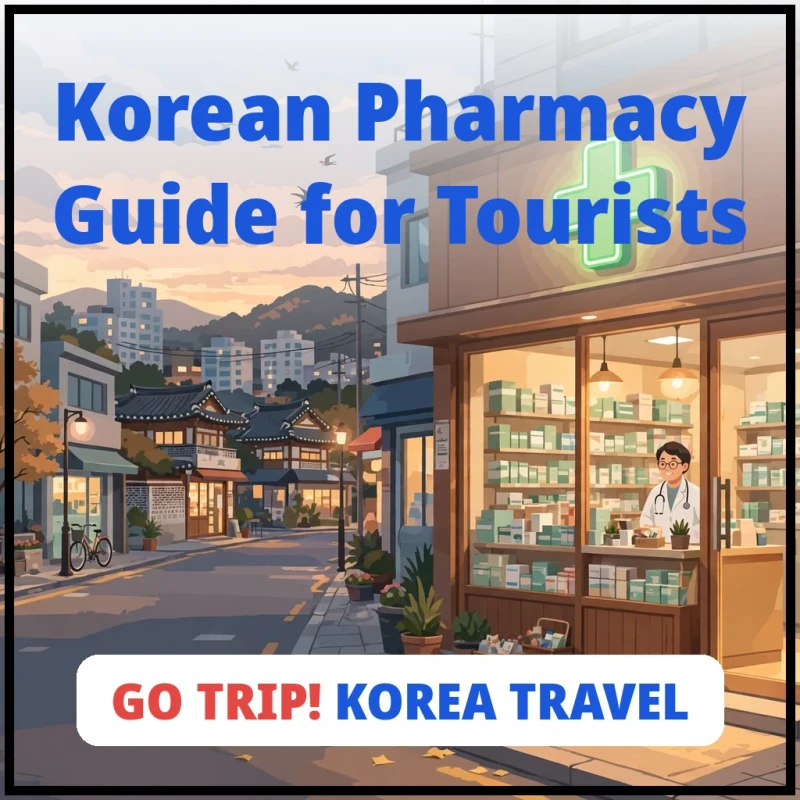
Korean pharmacy guide — a glowing green-cross pharmacy storefront on a Seoul street at dusk, pharmacist at the counter

Caught a cold in Seoul, or just need painkillers, plasters, or something for an upset stomach? A Korean pharmacy (약국, yakguk) is the fastest fix — and you do not need an appointment, a prescription, or fluent Korean for the everyday medicines tourists actually need. Look for the glowing green cross, describe your symptoms, and the pharmacist picks the right product on the spot. This guide covers what you can buy without a prescription, the real Korean brand names to ask for, the exact phrases that work at the counter, opening hours, and what to do at 2 a.m. when every pharmacy looks closed. For the basics of paying and carrying cash in Korea, see our Korea travel money guide.

Read this first: prices and hours below were checked on November 14, 2026 against 2026 guides and official finders — re-confirm on the official site or a map app in the week you travel, especially late-night pharmacy hours, which vary by district. This post is general travel information, not medical advice: if symptoms are severe, worsening, or you take other medication, tell the pharmacist, or call 1339 (24-hour health information line) or 119 in an emergency.

Key Takeaways

  • Look for the green cross and the word 약국 (yakguk): Korea has about 25,000 pharmacies, and most city blocks have one within a short walk. No appointment or prescription is needed for basic pain, fever, cold, allergy, and stomach medicine.
  • Describe symptoms, not brands: show the pharmacist the Korean word for your symptom, or the active ingredient on your medicine from home (acetaminophen, ibuprofen, loratadine) — brand names differ, ingredients do not.
  • Expect to pay about ₩3,000–₩10,000 per item: Tylenol runs about ₩3,000–₩5,000 and cold medicine about ₩3,000–₩6,000. A government-set surcharge of about 30% applies at night (after 6 p.m.) and on Sundays and public holidays.
  • Antibiotics need a Korean doctor: since 2000, prescribing and dispensing have been separated in Korea, so antibiotics and stronger painkillers require a clinic visit first — the pharmacy alone cannot sell them.
  • After hours, use a late-night pharmacy or a convenience store: Seoul runs about 40 public late-night pharmacies (10 p.m.–1 a.m.), and registered 24-hour convenience stores sell 11 basic medicines around the clock.

Contents

  • Finding a Pharmacy: What to Look For
  • What You Can Buy Without a Prescription
  • How to Ask in Korean: Phrases That Work
  • Opening Hours, Sundays & Late-Night Options
  • Costs, Payment & Practical Tips
  • FAQ

Finding a Pharmacy: What to Look For

A Korean pharmacy is a standalone shop, not a counter inside a supermarket. The signs to look for are a glowing green cross and the word 약국 (yakguk); many also show a round red 약 (yak, "medicine") sign. With about 25,000 pharmacies across the country, you will find several within walking distance in any city centre, and they cluster thickly around subway exits and in tourist shopping districts — the photo below is Myeongdong Station, where pharmacies sit a few steps from the gates. The easiest way to find the nearest one is to search 약국 on Naver Map or KakaoMap, which shows opening hours and walking distance; the same search works with 심야약국 (simya yakguk, "late-night pharmacy") after dark.

Myeongdong Station fare gates in Seoul — pharmacies cluster around subway exits in busy districts

Photo: LERK / Wikimedia Commons (CC BY-SA 4.0) — Myeongdong Station fare gates; pharmacies cluster around subway exits

Do not confuse a pharmacy with Olive Young or another beauty store. Olive Young sells cosmetics and some health products, but the pharmacy-only medicines — including the acne cream Acnon and the scar gel Noscana that many visitors ask for — are sold only at a real 약국. If the shop has no green cross and no pharmacist behind the counter, it is not a pharmacy.


What You Can Buy Without a Prescription

At a Korean pharmacy, the pharmacist expects you to describe a symptom, not name a brand. The everyday medicines below are general medicines (일반의약품) that you can buy over the counter, with no prescription and no appointment. Always tell the pharmacist if you take other medication, are pregnant, or have allergies — they will ask, and the answer changes what they can sell you.

Myeongdong shopping street in Seoul, where about 30 visitor-oriented pharmacies stock English-labelled products

Photo: Izzatfikry99 / Wikimedia Commons (CC BY 4.0) — Myeongdong shopping street, home to about 30 visitor-oriented pharmacies

SymptomWhat to ask forTypical price (KRW)
Headache, fever, period painPain and fever reliever — Tylenol (타이레놀, acetaminophen) or ibuprofen (이부프로펜, e.g. Brufen)About ₩3,000–₩5,000
Cold: runny nose, cough, sore throat, feverMulti-symptom cold medicine — Pancold-A (판콜에이) or WhitubenAbout ₩3,000–₩6,000
Upset stomach, indigestionDigestive aid — Bearse (베아제) or Festal Plus tabletsAbout ₩3,000–₩6,000
Sore muscles, stiff backPain-relief patch — Shinshin Pas Arex (신신파스 아렉스)About ₩3,000–₩5,000
Allergy: sneezing, itchy eyesAntihistamine — ask for the loratadine or cetirizine product (show the ingredient name)About ₩3,000–₩10,000
Motion sickness, minor cuts and scrapesMotion-sickness pills, antiseptic and bandages — describe the symptom at the counterAbout ₩3,000–₩10,000

What you cannot buy over the counter: antibiotics and stronger painkillers are prescription-only in Korea. Since 2000, prescribing and dispensing have been separated (의약분업), so the route is always the same: visit a neighbourhood clinic first, then bring the prescription paper (처방전) to the pharmacy. No pharmacy can sell you antibiotics without one, however you ask.

Two things visitors often buy that are not at Olive Young: Acnon Cream (acne) and Noscana Gel (scars), both from Dong-A Pharmaceutical, are over-the-counter medicines sold only in pharmacies — that is why they are not on beauty-store shelves. In Myeongdong, where merchants count about 30 pharmacies aimed at visitors, staff often speak some Chinese or Japanese and price tags are in English. Prices for these are set at the counter — ask before you buy.

Bringing medicine into Korea: some common foreign medicines are restricted at Korean customs, and enforcement tightened in April 2025. Anything containing pseudoephedrine (common in Western cold and sinus brands such as Sudafed) needs advance approval from the Ministry of Food and Drug Safety, and Japan's EVE painkiller and Pabron Gold A cold medicine are restricted (Pabron Gold A contains dihydrocodeine). Check the MFDS list before you pack — it is much easier to buy the Korean equivalent here than to argue at the airport.

How to Ask in Korean: Phrases That Work

You do not need Korean to use a pharmacy — but one or two words make the counter visit much faster, especially outside the tourist districts, where the pharmacist's English may be basic. The pattern is simple: say the symptom, then add 주세요 (juseyo, "please give me"). Show the pharmacist the empty box or a photo of the medicine you take at home, with the active ingredient visible, and they can match it to a Korean product. A translation app (Papago or Google Translate) also works well — point at the symptom and let the app speak.

SituationSay this (Korean)PronunciationMeaning
Finding a pharmacy약국이 어디예요?yakgugi eodiyeyo?Where is the pharmacy?
Asking for cold medicine감기약 주세요gamgiyak juseyoCold medicine, please
I have a cold감기 걸렸어요gamgi geollyeosseoyoI caught a cold
I have a fever열이 나요yeori nayoI have a fever
I have a runny nose콧물이 나요konmuri nayoI have a runny nose
I have a cough기침이 나요gichimi nayoI have a cough
My throat hurts목이 아파요mogi apayoMy throat hurts
My head hurts머리가 아파요meoriga apayoI have a headache
My stomach hurts배가 아파요baega apayoMy stomach hurts

Understanding the pharmacist's reply: the most common instruction you will hear is 하루 세 번, 식후 30분에 드세요 (haru se beon, sikhu samsip-bune deuseyo) — "take it three times a day, 30 minutes after meals." If you are unsure, ask them to write the dose down, or photograph the box: Korean medicine boxes print the dosage in Korean, and a translation app reads it reliably. And if the pharmacist asks 어디가 아프세요? (eodiga apeuseyo?) — "what hurts?" — point to where it hurts and use one of the phrases above.

Opening Hours, Sundays & Late-Night Options

Ordinary neighbourhood pharmacies keep shop hours: typically about 9 a.m. to 7 or 9 p.m. on weekdays, shorter hours on Saturdays, and many are closed on Sundays and public holidays. Pharmacies near large hospitals often stay open later, until about 10 p.m., and tourist-district pharmacies in places like Myeongdong and Hongdae also keep longer hours. Always check the hours on Naver Map before you walk over — the listing is usually accurate, and the pharmacy's own sign at the door shows the same times.

Late at night (10 p.m.–1 a.m.): Korea runs a designated late-night pharmacy network — about 240 late-night pharmacies nationwide, including about 40 across Seoul's 25 districts — open from 10 p.m. to 1 a.m. To find one, search 심야약국 on Naver Map or KakaoMap, use the Korean Pharmaceutical Association's holiday pharmacy finder (pharm114.or.kr), or the National Emergency Medical Center's E-Gen site (e-gen.or.kr). You can also call 1339, the 24-hour medical information line, which can point you to the nearest open pharmacy. Expect a modest surcharge at night — it is standard, government-set pricing, not a tourist markup (see Section 5).

When every pharmacy is closed: registered 24-hour convenience stores (CU, GS25, 7-Eleven, Emart24) sell a short government list of safe household medicines (안전상비의약품) — a system in place since November 2012. The Ministry of Health and Welfare lists 13 items, but two children's Tylenol tablets have been out of production since 2022, so 11 items are actually on sale: Tylenol 500mg tablets, Pancold-A oral liquid, Panpyrin-T tablets, digestive aids (Bearse, Festal Plus), pain-relief patches (Shinshin Pas Arex), and children's fever syrup. The rules: the store must be open 24 hours and registered with the local health office (look for the sticker near the door), you can buy one pack per item at a time, and the medicines are not sold to children under 12. In July 2026 the ministry said it would expand the list to as many as 20 items, with the official notice to be amended in December 2026 — so the shelf may look a little different by the time you travel. For what else these stores sell around the clock, see our Korean convenience store food guide.

A GS25 convenience store in Seoul — registered 24-hour stores sell 11 basic medicines at night

Photo: Striker9498 / Wikimedia Commons (CC BY-SA 3.0) — a GS25 in Seoul; registered 24-hour convenience stores sell 11 basic medicines at night

On Sundays and public holidays: the number of open pharmacies drops sharply. Plan ahead: buy what you might need on Saturday, and on a holiday use the pharm114.or.kr finder or call 1339 rather than walking street to street. If you need a doctor rather than a pharmacist, the Korea Travel Hotline 1330 runs around the clock in English and can connect you to 119 in a medical situation.

Costs, Payment & Practical Tips

What medicine costs in Korea

Medicine is cheap in Korea compared with most Western countries, and the prices below are the ranges 2026 guides list for a standard pack. Re-confirm at the counter before you buy — prices vary a little by pharmacy, and the night and holiday surcharge applies on top.

ItemApprox. cost (KRW)Notes
Tylenol (acetaminophen) — pain and feverAbout ₩3,000–₩5,000Standard pack; also sold at convenience stores (500mg tablets)
Cold medicine (Pancold-A, Whituben)About ₩3,000–₩6,000Multi-symptom liquid or tablets; Pancol-A liquid also at convenience stores
Digestive aid (Bearse, Festal Plus)About ₩3,000–₩6,000Also sold at convenience stores
Pain-relief patch (Shinshin Pas Arex)About ₩3,000–₩5,000Also sold at convenience stores
Most other OTC itemsAbout ₩3,000–₩10,000Allergy medicine, motion-sickness pills, wound care — ask at the counter
Night / Sunday / holiday surchargeAbout +30%Government-set surcharge after 6 p.m. on weekdays, and on Sundays and public holidays

Payment and practical tips

Cards (Visa, Mastercard) are widely accepted across Korea, including at most pharmacies in tourist areas — see our Korea travel money guide for the details — but small neighbourhood pharmacies may prefer cash, so carry some won notes. No tipping is expected, and there is no need to haggle: pharmacy prices are set, and the night surcharge is fixed by regulation. Keep the box and receipt until you finish the medicine: the box has the dosage in Korean, the receipt helps if you need to ask a second pharmacist about the same product, and if you are flying home, the box proves what you bought. If you are staying in Seoul for a few days, the Seoul 3-day itinerary for first-time visitors shows where the pharmacy-dense districts (Myeongdong, Hongdae) sit in a normal sightseeing route, and the T-money card guide covers the transit card you will use to get there.

Sources checked November 14, 2026: the Seoul Metropolitan Government's Korean language lesson on getting sick in Korea (english.seoul.go.kr), the Korea pharmacy guides at Ur Korean BFF, Korean ofilter, Come on Korea, and Seoulstart, and the phrase guide at Learn Korean Hangul. Prices and hours change — confirm with the pharmacist or on the official finder before you buy.

🏨 Where to Stay in Seoul

Most visitors sleep in Seoul and sort out any pharmacy run from their hotel neighbourhood — Myeongdong and Hongdae have the densest pharmacy clusters. Compare live prices on Seoul hotels, from Myeongdong and Hongdae to Gangnam. Booking through this link supports this blog at no extra cost to you.

Check Seoul Hotels on Trip.com

This post contains affiliate links. We may earn a commission at no extra cost to you.

FAQ

Can tourists buy medicine at a Korean pharmacy without a prescription?

Yes — for everyday problems. Pain relievers, fever reducers, cold medicine, allergy pills, stomach remedies, motion-sickness pills, and basic wound care are sold over the counter with no prescription and no appointment: just describe your symptoms at a pharmacy (약국, yakguk). Antibiotics and stronger painkillers are prescription-only and need a clinic visit first.

What are the opening hours of pharmacies in Korea?

Most neighbourhood pharmacies open about 9 a.m. to 7 or 9 p.m. on weekdays, with shorter hours on Saturdays, and many are closed on Sundays and public holidays. Pharmacies near hospitals and in tourist districts often stay open later. Seoul also runs about 40 public late-night pharmacies open 10 p.m. to 1 a.m. — find them by searching 심야약국 on Naver Map, on pharm114.or.kr, or by calling 1339.

What should I say at the pharmacy if I have a cold?

Say 감기약 주세요 (gamgiyak juseyo — "cold medicine, please"), or describe the symptom: 감기 걸렸어요 (gamgi geollyeosseoyo, "I caught a cold"), 열이 나요 (yeori nayo, "I have a fever"), 콧물이 나요 (konmuri nayo, "I have a runny nose"), or 기침이 나요 (gichimi nayo, "I have a cough"). Showing the pharmacist the active ingredient on your medicine from home also works — brand names differ, ingredients do not.

Can I buy medicine at a convenience store at night in Korea?

Yes, but only a short list. Registered 24-hour convenience stores (CU, GS25, 7-Eleven, Emart24) sell 11 basic medicines: Tylenol 500mg, Pancol-A liquid, Panpyrin-T tablets, digestive aids, pain-relief patches, and children's fever syrup. You can buy one pack per item at a time, and the medicines are not sold to children under 12. For anything beyond that list, you need a real pharmacy or a late-night pharmacy.

How much does medicine cost at a Korean pharmacy, and can I pay by card?

Most over-the-counter items cost about ₩3,000–₩10,000: Tylenol about ₩3,000–₩5,000 and cold medicine about ₩3,000–₩6,000, with a government-set surcharge of about 30% at night (after 6 p.m.) and on Sundays and public holidays. Cards are widely accepted at pharmacies in tourist areas, but carry some cash for small neighbourhood shops. For a place to stay near the pharmacy-dense districts, compare hotels on Trip.com — booking through that link supports this blog at no extra cost to you.

Last updated: November 14, 2026. Prices and hours were checked on this date — re-confirm on the official site before you travel.

  • 0 Comments
Older Posts Home

About Go Trip!

Go Trip! is an independent English-language travel guide for people visiting Korea. Each post is written for first-time visitors: what a place is, how to get there, what it costs in Korean won, and what is worth booking before you arrive.

Prices, opening hours and transport details are checked against official sources (Visit Korea, Korail, city and venue websites) at the time of writing, and the sources are linked in every post so you can re-check them before you go.

Questions or corrections? Use the Contact page.

Labels

BUSAN JEJU SEOUL Travel to Korea

search

Book Your Trip

Affiliate Disclosure: The link below is an affiliate link. If you book through it, we may earn a commission at no extra cost to you.

Compare live hotel prices for Seoul, Busan and Jeju on Trip.com. Booking through this link supports this blog at no extra cost to you.

Check Hotels on Trip.com

  • About & Contact
  • Privacy policy
Created with by OmTemplates | Distributed By Gooyaabi Templates